Juggling Work, Bills & Healthcare
An independent professional may be managing clients, monthly expenses, and healthcare decisions at the same time.


IBN360 helps self-employed professionals, 1099 workers, contractors, entrepreneurs, and families access affordable healthcare and other resources they need.
Explore Your Options
IBN360 helps self-employed, 1099, and independent professionals get access to healthcare, financial, protection, and business
resources they may not receive through a traditional employer.

Healthcare
Navigation
Explore healthcare resources and learn about options that may be available.

Financial
Wellness
Find resources for managing money, debt, savings, and financial goals.

Protection
Planning
Learn about protection resources and available planning options.

Business
Resources
Find information and resources for freelancers, contractors, and entrepreneurs.

Professional
Guidance
Start with a few questions and explore from there.
Explore Your Options
IBN360 helps self-employed, 1099, and independent professionals get access to healthcare, financial, protection, and business resources they may not receive through a traditional employer.

Healthcare
Navigation
Explore healthcare resources and learn about options that may be available.

Financial
Wellness
Find resources for managing money, debt, savings, and financial goals.

Protection
Planning
Learn about protection resources and available planning options.

Business
Resources
Find information and resources for freelancers, contractors, and entrepreneurs.

Professional
Guidance
Start with a few questions and explore from there.
Traditional benefits don't always work for people outside traditional employment. IBN360 provides healthcare and other resources for:
Self-employed professionals who manage their own benefits.
1099 workers and contractors who don't receive traditional employer benefits.
Freelancers and entrepreneurs who need resources that work outside a traditional workplace.
People between jobs who need another way to access healthcare.
Individuals and families looking for affordable healthcare options.
Traditional benefits don't always work for people outside traditional employment.
IBN360 provides healthcare and other resources for:
Self-employed professionals who manage their own benefits.
1099 workers and contractors who don't receive traditional employer benefits.
Freelancers and entrepreneurs who need resources that work outside a traditional workplace.
People between jobs who need another way to access healthcare.
Individuals and families looking for affordable healthcare options.
Independent work comes with a lot to manage. Here are a few everyday situations and resources you can explore through IBN360.
An independent professional may be managing clients, monthly expenses, and healthcare decisions at the same time.
Freelance and contract income can vary while bills and everyday financial responsibilities continue.
Planning for income, family responsibilities, and the future can be another thing to manage alongside work.
Business owners often balance customers, daily operations, personal finances, and other responsibilities.
Example situations are for educational and illustrative purposes only. Resources, eligibility, costs, benefits, and availability may vary.
Support that isn't tied to one employer
The way people work has changed. Benefits should work for people who are self-employed, freelance, contract, run a business, or move between jobs.
Explore: See what's available based on what you're looking for.
Learn: Understand your options in simple language.
Ask: Get additional guidance when you have questions.
Decide: Choose what makes sense for your situation.
No pressure. No complicated process.

"Health Insurance Success Story"
Finally an affordable health insurance policy for the whole family. Independent contractors and 1099 workers are no longer out in the cold when it comes to healthcare. Be rewarded for your healthy lifestyle and tenacity to go it alone and don’t worry about premiums that drain your bank account.

"Licensed IBN360
Specialist"
I’m in awe of how simple and fast the process is to get clients price quotes and breakdown of the advantages IBN360 offers so that they can compare to their current situations. Not one has been disappointed with what they’ve heard. After a quick 10-minute information gathering, clients are set up and good to go. You can feel their sighs of relief.

"Health Insurance Success Story"
With health insurance premiums continuing to rise, I am so grateful to have found this program. Now I finally have an affordable and customizable health insurance plan for me and my family. Thank you IBN360!

"Health Insurance
Quote"
The switch to this plan saved my wife $450/mth ($5,400/yr); which also included a deductible that was $6,000 lower. Her PCP was in-network. Our family is thrilled and grateful to have such a positive financial impact.

Health insurance shopping can feel like you need a dictionary, a calculator, and a nap. And when money is already tight, picking the wrong plan is not just annoying. It can turn one random doctor visit into a financial spiral.
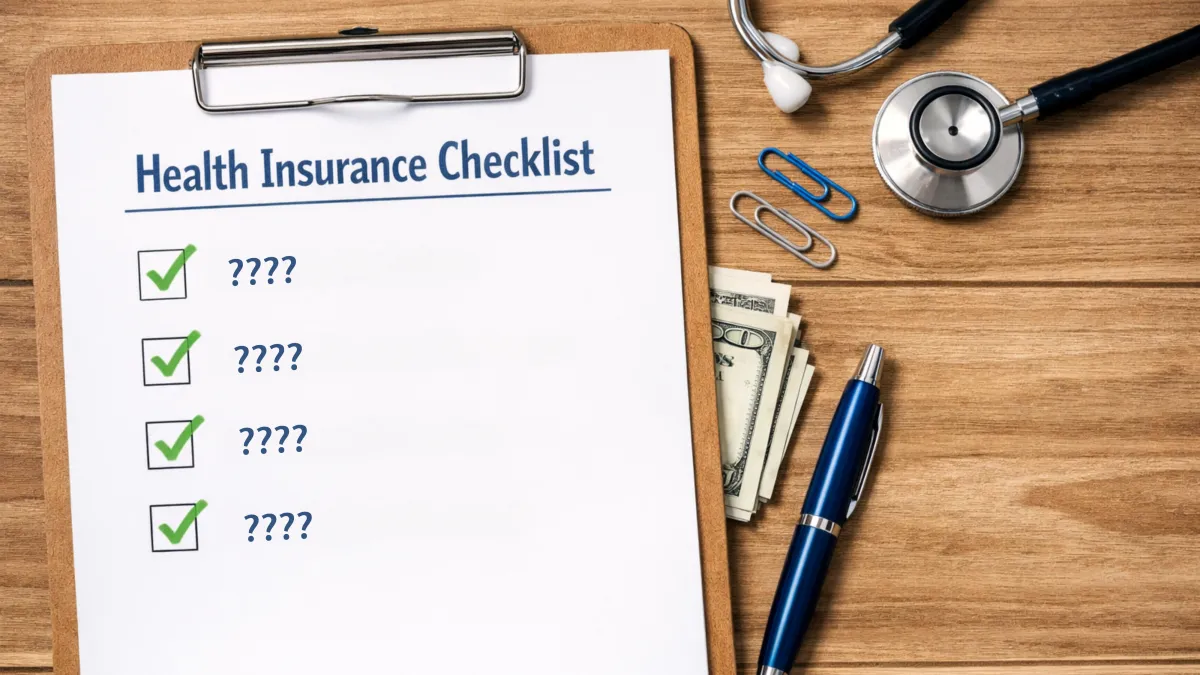
You do not need to be an expert to choose a good plan. You just need a simple way to check four things: what you pay every month, what you could pay in a bad year, whether your doctors are included, and whether your medications are covered the way you expect.
A plan is only “good” if you can afford to use it when you need care. That sounds basic, but it is the real-world test. If using the plan feels so expensive that you avoid appointments, you are paying for coverage that you cannot comfortably use.
This is a real problem for a lot of Americans. KFF reported on January 29, 2026 that about 36% of adults said they skipped or postponed getting health care they needed in the past 12 months because of the cost. (Source: KFF)
That is why this checklist focuses on what your costs and access look like in real life, not just what the plan promises in a brochure.
Start with the monthly premium, because that is the bill you must pay to keep coverage active. Then immediately look at the out-of-pocket maximum, because that is the number that tells you how protected you are if you have a rough year.
HealthCare.gov explains that the out-of-pocket maximum is the most you have to pay for covered services in a plan year, and after you spend that amount on deductibles, copayments, and coinsurance for covered in-network care, your plan pays 100% of covered benefits. It also clarifies that premiums, out-of-network care, and non-covered services do not count toward that limit. (Source: HealthCare.gov)
If you want a simple safety check, treat the out-of-pocket maximum as your “bad year number.” If that number would wreck your finances, the plan might be too risky, even if the monthly premium looks affordable.
Once the money part makes sense, the next step is making sure you can actually use the plan where you live. That means your preferred doctors, nearby clinics, and the hospital you would want in an emergency should be in the plan’s network.
This is also where people get tripped up, because a plan can have a decent premium and still cost you more if you keep getting pushed out-of-network. HealthCare.gov’s plan comparison guidance highlights checking networks and covered services so you understand what care is available to you under each option. (Source: HealthCare.gov)
If you are comparing two plans and one includes your real doctors while the other does not, that “cheaper” plan may not be cheaper in real life.
Next, check your meds. Two plans can look identical on price, but handle prescriptions very differently, and that difference can quietly drain your budget all year.
HealthCare.gov explains that Marketplace plans help pay for certain prescription medications, and that medications on a plan’s formulary, meaning its approved drug list, are usually less expensive than drugs that are not on the list. It also points people to practical checks like reviewing the plan’s covered drug list and the Summary of Benefits and Coverage. (Source: HealthCare.gov)
When you look up your meds, pay attention to whether the plan adds extra steps like prior authorization or limits. Those details affect how smooth and affordable your refills will feel month to month.
At this point, you should have a clear answer. A good plan is one where the premium fits your monthly budget, the out-of-pocket maximum is a number you could survive in a bad year, your doctors and hospitals are in-network, and your prescriptions are covered in a way that matches your routine.
If you want to keep learning without getting overwhelmed, start with the Blog Hub so you can pick the topic that matches your situation. Then, if you want a quick method to compare two plans using real numbers, this guide on estimating total yearly cost makes the math feel less guessy. If you are self-employed or contract-based, this 1099 guide helps you apply the same checklist when income is not steady.
And if you want someone to sanity-check your top choices with you, you can book a quick coverage review through IBN360 Healthcare and get help narrowing options based on your budget, doctors, and prescriptions.
Get covered with confidence through IBN360. Book a call today.
For more stories and insights, visit IBN360 Blog Hub.


"Health Insurance Success Story"
Finally an affordable health insurance policy for the whole family. Independent contractors and 1099 workers are no longer out in the cold when it comes to healthcare. Be rewarded for your healthy lifestyle and tenacity to go it alone and don’t worry about premiums that drain your bank account.

"Licensed IBN360
Specialist"
I’m in awe of how simple and fast the process is to get clients price quotes and breakdown of the advantages IBN360 offers so that they can compare to their current situations. Not one has been disappointed with what they’ve heard. After a quick 10-minute information gathering, clients are set up and good to go. You can feel their sighs of relief.

"Health Insurance Success Story"
With health insurance premiums continuing to rise, I am so grateful to have found this program. Now I finally have an affordable and customizable health insurance plan for me and my family. Thank you IBN360!

"Health Insurance
Quote"
The switch to this plan saved my wife $450/mth ($5,400/yr); which also included a deductible that was $6,000 lower. Her PCP was in-network. Our family is thrilled and grateful to have such a positive financial impact.

Health insurance shopping can feel like you need a dictionary, a calculator, and a nap. And when money is already tight, picking the wrong plan is not just annoying. It can turn one random doctor visit into a financial spiral.
You do not need to be an expert to choose a good plan. You just need a simple way to check four things: what you pay every month, what you could pay in a bad year, whether your doctors are included, and whether your medications are covered the way you expect.
A plan is only “good” if you can afford to use it when you need care. That sounds basic, but it is the real-world test. If using the plan feels so expensive that you avoid appointments, you are paying for coverage that you cannot comfortably use.
This is a real problem for a lot of Americans. KFF reported on January 29, 2026 that about 36% of adults said they skipped or postponed getting health care they needed in the past 12 months because of the cost. (Source: KFF)
That is why this checklist focuses on what your costs and access look like in real life, not just what the plan promises in a brochure.
Start with the monthly premium, because that is the bill you must pay to keep coverage active. Then immediately look at the out-of-pocket maximum, because that is the number that tells you how protected you are if you have a rough year.
HealthCare.gov explains that the out-of-pocket maximum is the most you have to pay for covered services in a plan year, and after you spend that amount on deductibles, copayments, and coinsurance for covered in-network care, your plan pays 100% of covered benefits. It also clarifies that premiums, out-of-network care, and non-covered services do not count toward that limit. (Source: HealthCare.gov)
If you want a simple safety check, treat the out-of-pocket maximum as your “bad year number.” If that number would wreck your finances, the plan might be too risky, even if the monthly premium looks affordable.
Once the money part makes sense, the next step is making sure you can actually use the plan where you live. That means your preferred doctors, nearby clinics, and the hospital you would want in an emergency should be in the plan’s network.
This is also where people get tripped up, because a plan can have a decent premium and still cost you more if you keep getting pushed out-of-network. HealthCare.gov’s plan comparison guidance highlights checking networks and covered services so you understand what care is available to you under each option. (Source: HealthCare.gov)
If you are comparing two plans and one includes your real doctors while the other does not, that “cheaper” plan may not be cheaper in real life.
Next, check your meds. Two plans can look identical on price, but handle prescriptions very differently, and that difference can quietly drain your budget all year.
HealthCare.gov explains that Marketplace plans help pay for certain prescription medications, and that medications on a plan’s formulary, meaning its approved drug list, are usually less expensive than drugs that are not on the list. It also points people to practical checks like reviewing the plan’s covered drug list and the Summary of Benefits and Coverage. (Source: HealthCare.gov)
When you look up your meds, pay attention to whether the plan adds extra steps like prior authorization or limits. Those details affect how smooth and affordable your refills will feel month to month.
At this point, you should have a clear answer. A good plan is one where the premium fits your monthly budget, the out-of-pocket maximum is a number you could survive in a bad year, your doctors and hospitals are in-network, and your prescriptions are covered in a way that matches your routine.
If you want to keep learning without getting overwhelmed, start with the Blog Hub so you can pick the topic that matches your situation. Then, if you want a quick method to compare two plans using real numbers, this guide on estimating total yearly cost makes the math feel less guessy. If you are self-employed or contract-based, this 1099 guide helps you apply the same checklist when income is not steady.
And if you want someone to sanity-check your top choices with you, you can book a quick coverage review through IBN360 Healthcare and get help narrowing options based on your budget, doctors, and prescriptions.
Get covered with confidence through IBN360. Book a call today.
For more stories and insights, visit IBN360 Blog Hub.

YOUR GOALS. YOUR CHOICES.
Get the Healthcare You Need at a Price That Works for You
Meet with an IBN360 specialist to learn about our healthcare network, review affordable pricing options, and get a quote based on your needs.
YOUR GOALS. YOUR CHOICES.
Get the Healthcare You Need at a Price That Works for You
Meet with an IBN360 specialist to learn about our healthcare network, review affordable pricing options, and get a quote based on your needs.

Copyright (c) 2026 IBN360. All rights reserved
Certain Programs and Benefits May Vary by States
IBN360 is a health coverage navigation platform. IBN360 is not a insurance carrier. All coverage discussions, quotes, and enrollments are handled by licensed specialists. Coverage availability, rates, and benefits vary by state.